

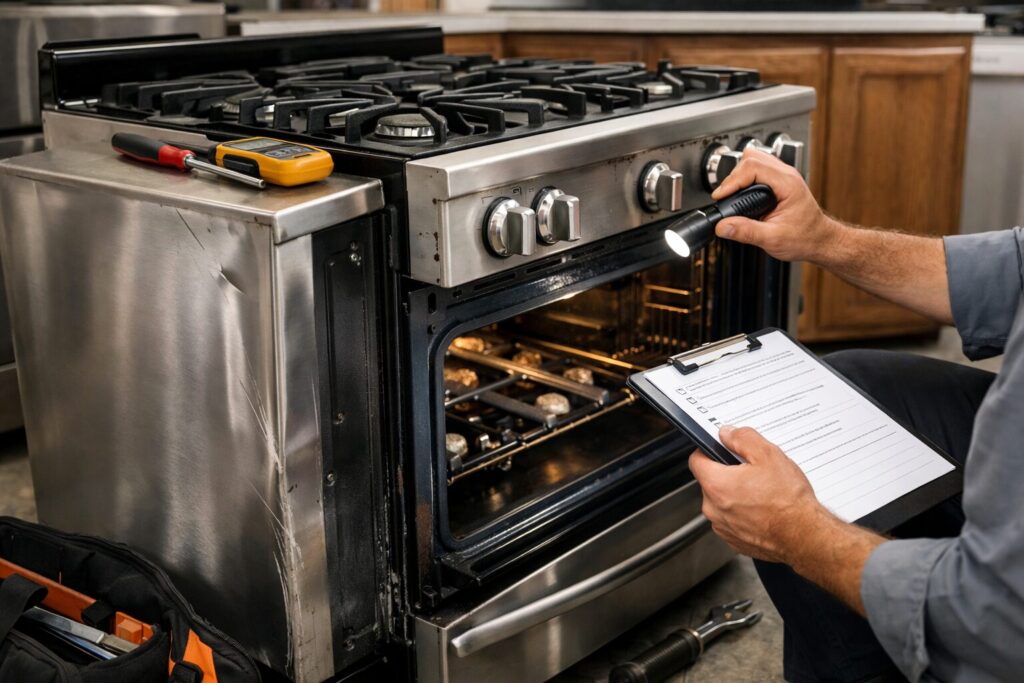
Are scratch and dent Gas Ranges inspected before resale?
Updated May 2026 – reflects current appliance inspection standards and scratch-and-dent gas range resale practices.
Yes. Most scratch and dent gas ranges are inspected for safety and core functionality before being resold, with retailers and warehouse outlets typically checking that key features—including burners, oven operation, and gas connections—work properly despite cosmetic flaws. While inspection standards can vary by retailer, buyers should always confirm what’s included in the inspection, and be aware that minor dents or scratches rarely affect cooking performance. Extended protection plans from providers like CPS can help cover unexpected breakdowns that occur after purchase, especially if you’re concerned about long-term reliability or expensive repairs.
Quick Summary: Scratch and Dent Gas Range Inspections
Here’s what you need to know about inspection practices and ownership considerations for scratch and dent gas ranges:
- Most scratch and dent gas ranges are checked for basic safety and working condition before resale
- Cosmetic issues usually do not affect performance, but buyers should confirm inspection details
- Inspection quality and warranty eligibility can vary by retailer or outlet
- Extended protection plans may help cover breakdowns or repairs that surface after purchase
- Many refurbished and scratch-and-dent gas ranges may qualify for CPS coverage or repair support
|
Topic |
Quick Take |
|---|---|
|
Inspection Before Resale |
Most scratch and dent gas ranges undergo safety and function checks |
|
What’s Covered in Inspection? |
Core features (burners, oven, gas connections) are typically tested |
|
Cosmetic vs. Functional Issues |
Cosmetic dents rarely impact performance or safety |
|
Warranty Eligibility |
Many scratch and dent ranges are eligible for extended protection |
|
Repair Support |
CPS offers help with post-warranty repairs and coverage |
free
Limited Time Offer
Get 3 months free on any protection plan.
Don’t wait for something to break. Get covered today and your first three months are on us.
What Should You Look For When Buying a Scratch and Dent Gas Range?
When shopping for a scratch and dent gas range, it’s important to look beyond surface blemishes and focus on inspection standards, functional testing, and available protection options. Customers often want to know what’s actually checked before resale and what coverage is available for future repairs.
- Confirmation of full safety and operational inspection before purchase
- Documentation of what was checked (burners, oven, gas lines, ignition)
- Eligibility for extended protection or repair coverage
- Clarity on cosmetic vs. functional issues
- Repair support options in case of future breakdowns
What Experience Does CPS Have With Gas Range Repairs and Protection?
With more than 75 million products covered and 60 million customers insured, CPS has extensive experience supporting gas range owners with repair claims, troubleshooting, and long-term appliance protection. Based on decades of claims administration, a network of 50,000 servicers, and hundreds of millions in claims paid annually, CPS understands the most common repair issues and ownership concerns for both new and scratch-and-dent appliances.
- Gas range ignition and burner problems are frequent repair concerns after several years of use
- Control board and oven temperature issues are common in both standard and premium models
- Cosmetic imperfections generally don’t affect mechanical reliability, but internal component failures can be expensive
- Based on historical claims, post-warranty repairs for gas ranges often involve replacing igniters, thermostats, or gas valves
- CPS coordinates repairs with a large network of authorized servicers nationwide
What Gas Range Repairs Are Most Common After Warranty Expiration?
Based on CPS’s historical claims data and long-term repair experience, gas range owners most often face repairs related to ignition systems, control boards, and oven heating issues after the manufacturer warranty expires. Cosmetic dents rarely cause functional failures, but it’s the internal components that typically drive repair costs for long-term owners.
|
Product or Repair Type |
Common Issue |
Why It Can Be Expensive or Important |
CPS Repair Insights |
|---|---|---|---|
|
Gas Range Ignition System |
Igniter not sparking or clicking |
Requires replacement parts and labor for safe operation |
CPS claims data shows ignition failures often appear 2–4 years into ownership, shortly after warranty expiration. Approved repairs typically run $230–$420, with repeat visits when spark modules, igniter switches, or wiring harnesses also show grease or heat-related wear. |
|
Oven Control Board |
Temperature not accurate or oven not heating |
Electronic diagnostics and specialized replacement |
Historical CPS repair data suggests control board issues commonly occur 3–6 years after purchase. Invoices often land between $315–$625 because diagnostics, relay board replacement, and temperature calibration can push the repair close to 40%–50% of replacement value. |
|
Gas Valve or Regulator |
Gas leaks or inconsistent flame |
Safety-critical parts and certified repair required |
Based on CPS claim trends, gas valve and regulator repairs are less frequent but higher urgency. Certified repairs usually range from $275–$575, with approvals tied closely to safety verification, leak testing, and whether burner valves or flame sensors are also affected. |
|
Burner Assembly |
Burner not lighting or uneven flame |
Can involve part replacement and disassembly |
CPS claims activity indicates burner assembly problems often develop during mid-life ownership as spills, grease intrusion, and thermal cycling affect ignition consistency. Repairs typically run $210–$390, but multi-burner service can escalate invoices by 20%–35%. |
|
Oven Door or Hinges |
Loose or misaligned door |
Affects heating efficiency and safety |
CPS repair history shows hinge and door-seal issues usually appear 4–7 years into ownership. Repairs often cost $185–$360, but repeat service becomes more likely when misalignment affects heat retention, cooking performance, or latch safety. |
Why Do Customers Choose CPS Protection Plans?
Customers choose CPS protection plans for flexible coverage options, practical repair support, and the ability to protect both standard and scratch-and-dent appliances. Easy claims, nationwide repair network access, and support for refurbished products are key advantages.
- Access to repair support for gas ranges, ovens, and premium appliances
- Eligibility for many refurbished, open-box, and scratch-and-dent products
- Help coordinating repairs after manufacturer warranty expiration
- Support for expensive mechanical and electronic repairs
- Simple claims process and expert guidance
Can CPS Help if My Appliance Is Already Out of Warranty?
After the manufacturer warranty expires, CPS may still be able to help with troubleshooting, repair referrals, and—in some cases—extended protection options for eligible scratch and dent gas ranges.
- Factory-authorized repair referral assistance for gas ranges and major appliances
- Troubleshooting guidance and repair coordination for out-of-warranty issues
- Help locating replacement parts and authorized service providers
- Guidance on eligibility for extended protection plans after the original purchase when applicable
|
Contact Method |
Details |
Best For |
|---|---|---|
|
Phone |
(800) 905-0443 |
Speaking directly with a CPS representative |
|
Web Chat |
|
Quick support and troubleshooting guidance |
|
CPS Client Care Portal |
https://client.cpscentral.com/ |
Claims, account access, and service support |
|
Text Message |
Text (347) 621-7180 |
Quick customer support questions |
|
Facebook Messenger |
http://m.me/ConsumerPriorityService |
General support and communication |
|
|
cs@cpscentral.com |
Detailed questions and documentation |
What Should You Know About Scratch and Dent Gas Range Coverage?
Are scratch and dent gas ranges checked before being sold?
Yes, most retailers inspect scratch and dent gas ranges for core safety and functionality before resale. This usually includes checking burners, oven operation, and gas connections, but the depth of inspection can vary by seller.
Do cosmetic dents affect the performance of a gas range?
Cosmetic dents typically do not impact how a gas range cooks or operates. The main concern for buyers should be whether all mechanical and gas features are working safely.
Can I get a warranty for a scratch and dent gas range?
In many cases, yes. Many scratch and dent gas ranges are eligible for extended protection plans or repair support, but eligibility may depend on the retailer and the product’s condition.
What does an inspection typically include for a scratch and dent gas range?
Inspections usually cover basic functions like burner ignition, oven heat, gas line integrity, and overall operational safety. Cosmetic flaws are noted but do not usually affect the inspection outcome.
Are repairs more common with scratch and dent gas ranges?
Based on CPS’s historical claims data, mechanical issues are not necessarily more common in scratch and dent units if they pass functional inspection. However, like any appliance, repairs may be needed as the product ages.
What are the most expensive repairs for gas ranges?
Ignition system failures, control board replacements, and gas valve repairs are among the costlier fixes, especially after the manufacturer warranty has expired.
How do I know if a scratch and dent gas range is safe?
Ask the retailer for inspection documentation and verify that all gas and electrical functions have been checked for safety. If in doubt, a licensed technician can provide a post-purchase safety inspection.
Can I still get help if my scratch and dent gas range is out of warranty?
Yes. CPS may be able to assist with troubleshooting guidance, repair referrals, and—in some cases—extended protection eligibility, depending on your product’s condition and purchase details.
What should I check before buying a scratch and dent gas range?
Confirm that the appliance has passed a recent safety and function inspection, ask about warranty or protection plan options, and carefully review the cosmetic damage to ensure it won’t affect your kitchen setup.
repair
No Hidden Fees
One price covers all parts, labor, makes & models.
Skip the guesswork. Our flat rate repair program means you know exactly what you’ll pay — before we start.
Want to Learn More About Gas Range Coverage or Repair Support?
If you’re considering a scratch and dent gas range or want to protect your current appliance, CPS can help you explore coverage options, check eligibility, or answer repair questions.
For many homeowners, scratch and dent gas ranges offer significant savings, but it’s important to confirm that the appliance has been properly inspected and that support is available for any future repairs. Major components like igniters, control boards, and gas valves can be expensive to fix if issues arise after the sale—especially as the range ages or if it was purchased as a refurbished or open-box unit. Comparing repair support, protection plan eligibility, and inspection standards can help ensure long-term peace of mind. If you want to learn more about coverage options or need help assessing your product’s eligibility, CPS is here to assist.
 SPECIAL OFFER
 Coverage for scratch & dent models