

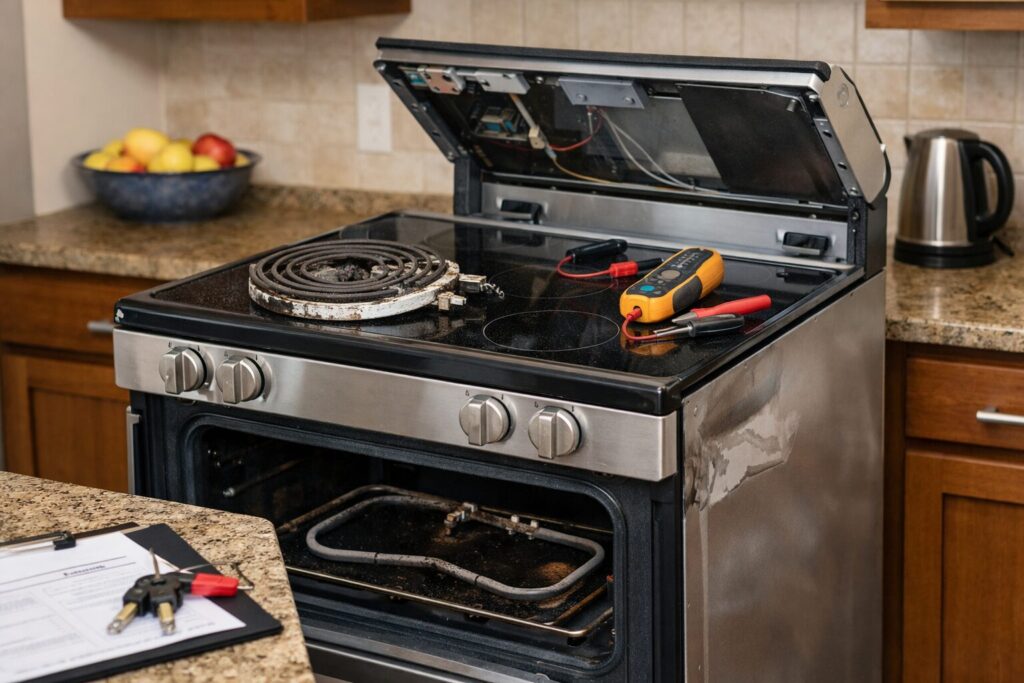
Are heating element failures more common on scratch and dent Electric Ranges?
Updated May 2026 – reflects current electric range repair trends and scratch and dent ownership concerns.
No, heating element failures are not significantly more common on scratch and dent electric ranges compared to standard models, as most cosmetic damage does not impact internal electrical components. Repair professionals and factory-authorized servicers typically find that visible scratches or dents on the exterior rarely affect the performance or reliability of heating elements. However, if the damage is severe enough to impact wiring or internal parts during shipping or handling, there can be an increased risk—but this is relatively uncommon with most scratch and dent products offered for sale. For customers considering a scratch and dent electric range, it’s important to confirm that the appliance has been inspected for functional integrity and that any extended protection plan covers mechanical and electrical failures, just as it would for a new unit. CPS offers protection options for many new, open-box, and scratch and dent appliances, helping customers manage post-warranty repair concerns and access factory-authorized service if issues arise.
Quick Summary: Heating Element Failures on Scratch and Dent Electric Ranges
Here’s what matters most when considering heating element reliability on scratch and dent electric ranges:
- Most scratch and dent ranges have cosmetic-only damage that does not affect heating element performance.
- Severe dents impacting internal wiring or components can increase repair risk, but this is relatively uncommon.
- Heating element failures are typically linked to age, usage, or internal electrical issues—not external scratches.
- Factory-authorized inspection and protection plans can help ensure long-term reliability after purchase.
- CPS covers many new, refurbished, and scratch and dent appliances for post-warranty mechanical and electrical failures.
|
Topic |
Quick Take |
|---|---|
|
Heating Element Failure Risk |
Not significantly higher on most scratch and dent ranges |
|
Common Cause of Failure |
Age, heavy use, or electrical issues—not cosmetic damage |
|
Inspection Importance |
Confirm no internal or wiring damage before purchase |
|
Protection Plan Eligibility |
CPS covers many scratch and dent and open-box appliances |
|
Repair Support |
Access to factory-authorized service if issues arise |
free
Limited Time Offer
Get 3 months free on any protection plan.
Don’t wait for something to break. Get covered today and your first three months are on us.
What Should You Look For When Buying a Scratch and Dent Electric Range?
When researching scratch and dent electric ranges, it’s important to pay attention to both the cosmetic and functional condition of the appliance. Customers often want to know what affects long-term reliability and how to protect against unexpected repairs. Here are the most important factors to consider:
- Functional inspection to confirm heating elements and wiring are undamaged
- Eligibility for extended protection covering electrical and mechanical failures
- Clear explanation of what damage is cosmetic versus structural
- Access to authorized repair networks for post-warranty issues
- Coverage for open-box, refurbished, or scratch and dent appliances
What Experience Does CPS Have With Electric Range Repairs and Scratch and Dent Appliances?
For customers comparing protection plans for electric ranges—including scratch and dent models—CPS offers extensive claims experience, a large authorized repair network, and decades of operational knowledge. With more than 75 million products covered and $450 million in claims paid annually, CPS’s historical claims data provides practical insight into real-world repair concerns and common electric range failures.
- Heating element failures are typically linked to age or internal electrical issues, not exterior cosmetic damage
- Control board and wiring repairs are among the more common electric range claims
- Scratch and dent appliances are inspected for functional integrity before coverage eligibility
- CPS’s large repair network supports new, refurbished, and scratch and dent electric ranges
- Many post-warranty electric range repairs involve replacing internal components rather than addressing cosmetic issues
What Electric Range Repairs Are Most Common After Warranty Expiration?
Based on CPS’s historical claims data, heating element, control board, and wiring issues are among the most common post-warranty electric range repairs—regardless of whether the appliance is new or scratch and dent. Cosmetic damage rarely impacts these internal failures, but functional inspections remain important for long-term reliability and repair planning.
|
Product or Repair Type |
Common Issue |
Why It Can Be Expensive or Important |
CPS Repair Insights |
|---|---|---|---|
|
Electric Range Heating Element |
No heat or uneven heating |
Requires replacement part and electrical diagnostics |
CPS claims data shows heating element failures are among the most common electric range repairs 3–6 years into ownership, especially shortly after manufacturer warranty expiration. Claims involving these failures typically require element replacement, terminal inspection, and electrical load testing, with approved repair totals commonly ranging from $240–$520 through the CPS network and often $450–$700 at retail service rates. Historical CPS repair data suggests roughly 30% of repeat heating complaints involve damaged receptacles or wiring connections discovered during follow-up diagnostics. |
|
Control Board |
Range not responding or error codes |
Advanced electronics and service labor |
Based on CPS claim trends, electronic control board failures frequently emerge during mid-life ownership periods after repeated thermal cycling and power fluctuations. CPS repair history shows these repairs often require firmware validation, relay-board replacement, and multiple diagnostic visits, with total claim costs commonly reaching $420–$980 depending on model complexity. Across approved CPS appliance claims, control board repairs approaching 50% of replacement value are more likely to shift toward replacement authorization on premium slide-in or smart-enabled ranges. |
|
Wiring or Terminal Block |
Range not powering on or intermittent function |
Electrical troubleshooting and potential safety concerns |
Service history from CPS claims indicates terminal block and internal wiring failures are commonly tied to overheating, loose electrical connections, or installation stress 4–8 years into ownership. Claims involving these failures typically require extensive electrical troubleshooting, wire harness replacement, and safety inspections, with invoice totals often escalating from initial estimates near $250 to final approvals exceeding $700 when additional heat damage is uncovered. CPS claims activity indicates intermittent power-loss complaints generate above-average repeat technician visits due to hidden wiring damage behind the appliance chassis. |
|
Oven Door Sensor |
Oven not heating or shutting off |
Sensors and wiring replacement |
According to historical CPS repair records, oven door sensor and latch-switch failures commonly occur after years of repeated high-temperature usage and self-clean cycle exposure. CPS claims data shows these repairs typically fall between $220–$480, though labor costs increase substantially when sensor wiring or locking assemblies require replacement. Based on CPS claims data from comparable repair events, nearly 25% of recurring oven shutdown complaints involve secondary control-board communication issues identified after the initial sensor replacement. |
|
Indicator Lights or Display |
Display not working or faulty indicators |
May require control board or wiring repair |
CPS claims activity indicates display failures and unresponsive indicator lights become more common 5–7 years into ownership as moisture exposure, heat stress, and board degradation affect electronic components. Historical CPS repair data suggests these claims frequently involve display boards, membrane switches, or user-interface assemblies, with approved repair costs commonly ranging from $280–$760 depending on parts availability. Claims involving smart-enabled ranges often experience longer repair timelines due to specialized display-module sourcing and calibration requirements after installation. |
Why Do Customers Choose CPS for Electric Range Protection and Repair Support?
Customers choose CPS for electric range coverage because of our experience with scratch and dent, refurbished, and new appliances, our nationwide authorized repair network, and our straightforward claims process. Here are some of the key benefits customers value most:
- Repair support for heating elements, control boards, and electrical components
- Eligibility for many scratch and dent, open-box, and refurbished appliances
- Nationwide access to factory-authorized repair professionals
- Assistance with post-warranty repairs and troubleshooting
- Simple claims process and long-term protection options
Can CPS Help if My Electric Range Is Already Out of Warranty?
After the manufacturer warranty expires, CPS may still be able to assist with troubleshooting guidance, repair network referrals, and protection plan eligibility for certain scratch and dent or open-box electric ranges. Many customers seek out-of-warranty repair support to avoid unexpected costs and extend their appliance’s useful life.
- Referral assistance to factory-authorized repair providers for out-of-warranty electric ranges
- Troubleshooting guidance and help locating replacement parts
- Support with repair coordination and post-warranty service options
- Eligibility checks for extended protection plans on certain scratch and dent or open-box appliances
|
Contact Method |
Details |
Best For |
|---|---|---|
|
Phone |
(800) 905-0443 |
Speaking directly with a CPS representative |
|
Web Chat |
|
Quick support and troubleshooting guidance |
|
CPS Client Care Portal |
https://client.cpscentral.com/ |
Claims, account access, and service support |
|
Text Message |
Text (347) 621-7180 |
Quick customer support questions |
|
Facebook Messenger |
http://m.me/ConsumerPriorityService |
General support and communication |
|
|
cs@cpscentral.com |
Detailed questions and documentation |
What Questions Do Customers Ask About Scratch and Dent Electric Range Coverage?
Are heating element failures more common on scratch and dent electric ranges?
No, most heating element failures on electric ranges are due to age, heavy use, or internal electrical issues—not cosmetic scratches or dents. Functional inspections help ensure reliability before sale.
Does cosmetic damage affect the performance of electric ranges?
Cosmetic damage like surface scratches or minor dents rarely affects the internal components or performance of electric ranges. Only severe damage that impacts wiring or internal parts could increase repair risk.
Should I be worried about buying a scratch and dent electric range?
As long as the appliance has passed a functional inspection and any damage is cosmetic only, scratch and dent electric ranges can be a good value. Always confirm warranty or protection plan eligibility for peace of mind.
Does CPS cover scratch and dent and open-box appliances?
Yes, CPS offers protection plans for many scratch and dent, open-box, and refurbished appliances as long as they meet eligibility requirements and have no pre-existing functional issues.
What types of repairs are most common on electric ranges?
Based on CPS’s historical claims data, heating element replacements, control board issues, and wiring repairs are among the most common electric range repairs—regardless of cosmetic condition.
Can I buy an extended warranty after purchasing a scratch and dent range?
In many cases, yes—if the product is still within the eligibility window and passes a functional inspection. CPS can help check your range’s eligibility for extended coverage.
What should I do if my electric range heating element stops working?
If your range isn’t heating, check for visible wiring issues, tripped breakers, or error codes. If the issue persists, contact a qualified repair provider or reach out to CPS for troubleshooting and repair support.
Are repairs more expensive for scratch and dent appliances?
Repair costs for scratch and dent electric ranges are generally the same as for new models, unless internal damage is present. Protection plans can help manage unexpected repair expenses.
Does a scratch and dent label mean the appliance has been repaired before?
Not necessarily. Most scratch and dent appliances are new but have minor cosmetic blemishes from shipping or handling. Always ask for a full inspection and functional report before purchase.
repair
No Hidden Fees
One price covers all parts, labor, makes & models.
Skip the guesswork. Our flat rate repair program means you know exactly what you’ll pay — before we start.
Want to Learn More About Protecting Your Electric Range?
If you’re considering a scratch and dent electric range or want to protect your appliance from unexpected repairs, CPS can help you explore coverage options and check eligibility.
For many customers, protection plans offer added peace of mind as appliances age or when buying scratch and dent models at a discount. Because most heating element failures are not caused by cosmetic damage, confirming functional integrity and understanding your repair support options can make a big difference in long-term ownership costs. If you want to compare protection plans or need help assessing your electric range’s eligibility, CPS is here to provide guidance and practical support.
 SPECIAL OFFER
 Coverage for scratch & dent models