

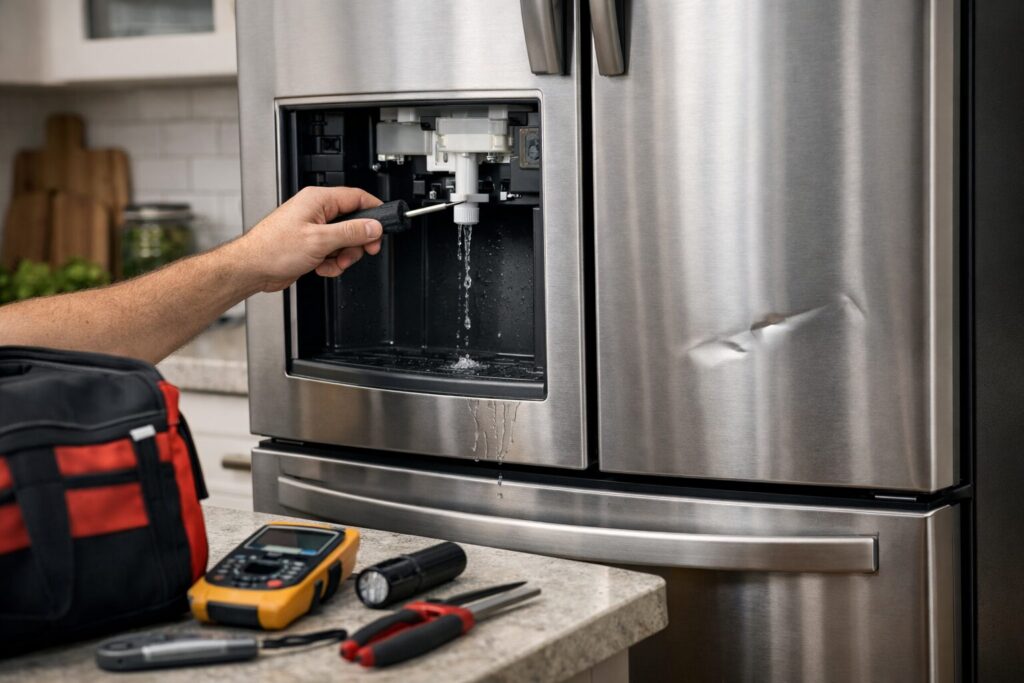
Is it common for scratch and dent French Door Refrigerators to have water dispenser issues?
Updated May 2026 – reflects current appliance repair trends, scratch and dent ownership concerns, and water dispenser issue reports.
Sometimes. Water dispenser issues can occur in scratch and dent French door refrigerators, but they are not universally common and often depend on where the cosmetic damage is located. Many water dispenser problems in these models are related to installation, water line kinks, frozen lines, or internal valve failures rather than the cosmetic dents or scratches themselves. However, if the scratch or dent affects the dispenser area, door, or internal plumbing, there could be a higher risk of leaks or dispenser malfunctions. Customers considering scratch and dent models should carefully inspect the door and dispenser area, ask about prior water line testing, and review warranty and protection plan options for coverage on mechanical or electrical failures. CPS supports coverage for many new, scratch and dent, and open-box refrigerators, with access to factory-authorized repair networks for eligible post-warranty repairs.
Quick Summary: Scratch and Dent French Door Refrigerator Water Dispenser Issues
Here’s what customers should know about water dispenser problems in scratch and dent French door refrigerators:
- Water dispenser issues are sometimes reported with French door refrigerators, but most are not caused by cosmetic dents alone.
- Problems often result from installation errors, kinked or frozen water lines, or internal valve failures.
- Dents or scratches near the dispenser area or door edge can increase the risk of leaks or dispenser malfunctions.
- Many scratch and dent refrigerators are eligible for extended protection plans covering mechanical and electrical failures.
- Factory-authorized repair access is important for complex dispenser or water system repairs after warranty expiration.
|
Topic |
Quick Take |
|---|---|
|
Are dispenser issues common? |
Sometimes, but usually depend on location of damage and installation quality |
|
Most likely causes |
Kinked/frozen lines, valve failures, or door-related damage |
|
When to be concerned |
If dents are near dispenser, door hinge, or internal water lines |
|
Protection plan coverage |
Available for many new, scratch and dent, and open-box models |
|
Repair support |
Factory-authorized repair is important for water system issues |
free
Limited Time Offer
Get 3 months free on any protection plan.
Don’t wait for something to break. Get covered today and your first three months are on us.
What Should You Look For When Buying a Scratch and Dent French Door Refrigerator?
When considering a scratch and dent French door refrigerator, it’s especially important to look beyond cosmetic flaws and focus on potential functional issues that could affect the water dispenser system. Customers often want to know what to check and what coverage options are available for post-warranty repairs.
- Inspect the dispenser area and door for dents that could affect internal water lines or controls
- Ask if the water dispenser and ice maker have been tested after any damage occurred
- Review protection plan eligibility for mechanical and electrical failures, not just cosmetic damage
- Check if the refrigerator is eligible for factory-authorized repair support
- Understand what repair costs may look like after the manufacturer warranty expires
What Experience Does CPS Have With French Door Refrigerator Repairs and Protection?
For many homeowners, repair costs and service reliability become top concerns with French door refrigerators, especially after manufacturer warranty expiration. With over 75 million products covered, 50,000 servicers nationwide, and decades of real-world claims experience, CPS has extensive expertise helping customers navigate water dispenser problems, internal plumbing issues, and electronic failures in French door models.
- Refrigerator water dispenser repairs are often related to frozen, kinked, or damaged water lines rather than cosmetic damage alone
- Control board and valve failures are common in modern French door refrigerators, requiring advanced diagnostics
- Scratch and dent units with door or hinge area impacts may have a higher risk of dispenser or ice maker issues
- Repairs can become more expensive as appliances age, especially for sealed system or electronic failures
- Based on historical claims data, many water dispenser issues are resolved with part replacement and professional repair coordination
What Water Dispenser and Refrigerator Repairs Are Most Common After Warranty Expiration?
Based on CPS’s historical claims data, water dispenser problems in French door refrigerators are most often linked to installation errors, kinked or frozen lines, or valve and control board failures—not simply cosmetic dents. However, dents near the dispenser or door edge can occasionally cause leaks or impact internal components, leading to more complex repairs after the original warranty expires.
|
Product or Repair Type |
Common Issue |
Why It Can Be Expensive or Important |
CPS Repair Insights |
|---|---|---|---|
|
French Door Refrigerator |
Water dispenser not working or leaking |
May require diagnosis of internal lines, valves, or control boards |
Based on CPS claims data from comparable refrigerator repairs, dispenser failures most commonly appear 2–5 years into ownership shortly after manufacturer warranty expiration. Historical CPS repair data suggests frozen water lines, failed inlet valves, and dispenser relay board faults account for nearly 60% of approved dispenser-related claims. Typical CPS-authorized repair invoices range from $280–$640, while retail consumer pricing often exceeds $800 once door disassembly and repeat diagnostics are involved. Claims activity indicates repeat service visits occur in roughly 25% of cases when intermittent leaks or wiring harness issues are initially misdiagnosed. |
|
Ice Maker |
Failure to produce ice or leaking |
Internal line or valve replacement, especially if impacted by dents |
CPS claims history shows ice maker failures frequently develop 3–6 years after purchase due to valve fatigue, frozen fill tubes, or motorized ejector assembly wear. Across approved CPS appliance claims, leak-related repairs commonly escalate when hidden door dents affect water-line routing or insulation performance. Typical repair approvals range from $320–$780 depending on valve accessibility and whether multiple components require replacement. Service history from CPS claims indicates nearly 30% of ice-maker complaints require secondary visits because moisture intrusion can damage nearby sensors or dispenser electronics over time. |
|
Door Seal/Closure |
Improper seal from dented door |
Can lead to cooling issues or moisture problems |
According to historical CPS repair records, door-seal and closure issues often become noticeable during mid-life ownership periods around 4–7 years into use, particularly after repeated door stress or minor impact damage. CPS claims data shows poor sealing can increase compressor runtime and contribute to moisture buildup, frost accumulation, and food spoilage complaints. Repair costs typically range from $240–$520 for gasket replacement, hinge correction, or door-alignment service, though severe door warping can push repairs near 40% of replacement value. Claims involving chronic sealing failures frequently show elevated repeat-visit rates because underlying frame alignment problems may not appear during initial inspection. |
|
Control Board |
Unresponsive dispenser controls |
Advanced electronic diagnostics and part replacement |
Historical CPS repair data suggests dispenser and refrigerator control-board failures are increasingly common in smart French door models 3–5 years into ownership due to voltage fluctuations, moisture exposure, and firmware-related communication faults. CPS claims activity indicates electronic diagnostics and board calibration contribute heavily to labor escalation, with approved repairs commonly totaling $450–$1,050. Claims involving these failures typically require specialty part sourcing and extended downtime because replacement boards often need model-specific programming. Based on CPS claim trends, repair-versus-replacement discussions increase substantially once multiple boards or display modules fail simultaneously. |
|
Sealed System |
Loss of cooling |
Specialized repairs and higher labor costs |
CPS repair history shows sealed-system failures remain among the most expensive post-warranty refrigerator repairs, commonly emerging 5–8 years into ownership as compressors, evaporators, or inverter systems experience thermal wear. Across approved CPS appliance claims, sealed-system invoices frequently range from $900–$1,800 due to refrigerant recovery, compressor replacement, and specialized labor requirements. Service history from CPS claims indicates many consumers delay these repairs because costs can approach 50%–60% of replacement value on aging units. Claims data also shows repeat cooling complaints are more likely when contamination or partial refrigerant restrictions are not fully resolved during the first repair event. |
Why Do Customers Trust CPS for Refrigerator Warranty Coverage?
Customers choose CPS for the combination of flexible coverage options, practical repair support, and extensive experience with a wide range of refrigerators—including scratch and dent, open-box, and premium models.
- Access to repair coordination and support for water dispenser, ice maker, and door-related issues
- Eligibility for many scratch and dent, open-box, and refurbished refrigerators
- Assistance with repairs after manufacturer warranty expiration
- Support for expensive electronic, valve, and sealed system failures
- Nationwide repair network and factory-authorized service options for eligible products
Can CPS Help if My Refrigerator Is Already Out of Warranty?
After the manufacturer warranty expires, CPS may still be able to assist with troubleshooting guidance, repair referrals, and even extended protection options for certain eligible scratch and dent refrigerators. Many customers want to understand both their repair options and possible coverage availability for future breakdowns.
- Factory-authorized repair referral assistance for water dispenser and refrigerator issues
- Troubleshooting guidance and repair coordination for out-of-warranty products
- Help locating replacement parts and service providers for older or scratch and dent units
- Guidance on extended protection eligibility for certain refrigerators after the original purchase or manufacturer warranty period
|
Contact Method |
Details |
Best For |
|---|---|---|
|
Phone |
(800) 905-0443 |
Speaking directly with a CPS representative |
|
Web Chat |
|
Quick support and troubleshooting guidance |
|
CPS Client Care Portal |
https://client.cpscentral.com/ |
Claims, account access, and service support |
|
Text Message |
Text (347) 621-7180 |
Quick customer support questions |
|
Facebook Messenger |
http://m.me/ConsumerPriorityService |
General support and communication |
|
|
cs@cpscentral.com |
Detailed questions and documentation |
What Questions Do Customers Ask About French Door Refrigerator Water Dispenser Issues?
Are water dispenser problems more common in scratch and dent French door refrigerators?
Not necessarily. Most water dispenser issues are due to installation errors, frozen lines, or valve failures, but dents near the dispenser or door can increase risk of leaks or malfunctions.
What should I check before buying a scratch and dent French door refrigerator?
Inspect the area around the water dispenser, door, and hinges for dents or damage that could affect internal water lines or controls. Ask if the dispenser and ice maker work and have been tested since the damage occurred.
Do protection plans cover water dispenser repairs on scratch and dent refrigerators?
Many extended protection plans, including those from CPS, cover mechanical and electrical failures like valve or control board issues, but not cosmetic damage or pre-existing problems.
Are water dispenser repairs expensive after the manufacturer warranty expires?
They can be, especially if the repair involves replacing internal water lines, valves, or control boards. Labor and parts costs often increase after warranty expiration.
Can dents cause water leaks from the dispenser?
If a dent directly affects the door area, dispenser components, or internal plumbing, leaks or malfunctioning dispensers are more likely. Cosmetic dents elsewhere are less likely to cause issues.
Are scratch and dent refrigerators eligible for extended protection?
Many scratch and dent refrigerators can be covered by CPS protection plans, as long as they are in working order at the time of plan activation and meet eligibility requirements.
What are the most common water dispenser issues in French door refrigerators?
Common issues include water not dispensing, slow flow, leaks, frozen or kinked water lines, and faulty valves or control boards.
Does CPS support repairs for open-box and refurbished refrigerators?
Yes, CPS offers coverage and repair support for many new, open-box, scratch and dent, and refurbished refrigerators, depending on product eligibility and condition.
What should I do if my water dispenser stops working after purchase?
First, check the water supply, line, and filter. If the problem persists, contact the seller or CPS for troubleshooting, repair referral, or claims support if you have coverage.
repair
No Hidden Fees
One price covers all parts, labor, makes & models.
Skip the guesswork. Our flat rate repair program means you know exactly what you’ll pay — before we start.
Looking for Warranty Coverage Options?
Explore protection plans and repair support options to help safeguard your refrigerator investment and cover expensive dispenser or internal water system repairs.
As French door refrigerators age, water dispenser and ice maker repairs can become more frequent, especially in units with prior cosmetic damage near the door or dispenser area. For many homeowners, protection plans offer peace of mind for mechanical and electrical failures after the manufacturer warranty expires, while out-of-warranty support can help with troubleshooting and repair referrals. Depending on your product’s age, condition, and prior repairs, exploring coverage or repair support may be a smart next step before unexpected issues arise.
 SPECIAL OFFER
 Coverage for scratch & dent models