

Can cosmetic damage affect the lifespan of a scratch and dent appliance?
Updated May 2026 – reflects current scratch and dent appliance repair and ownership trends.
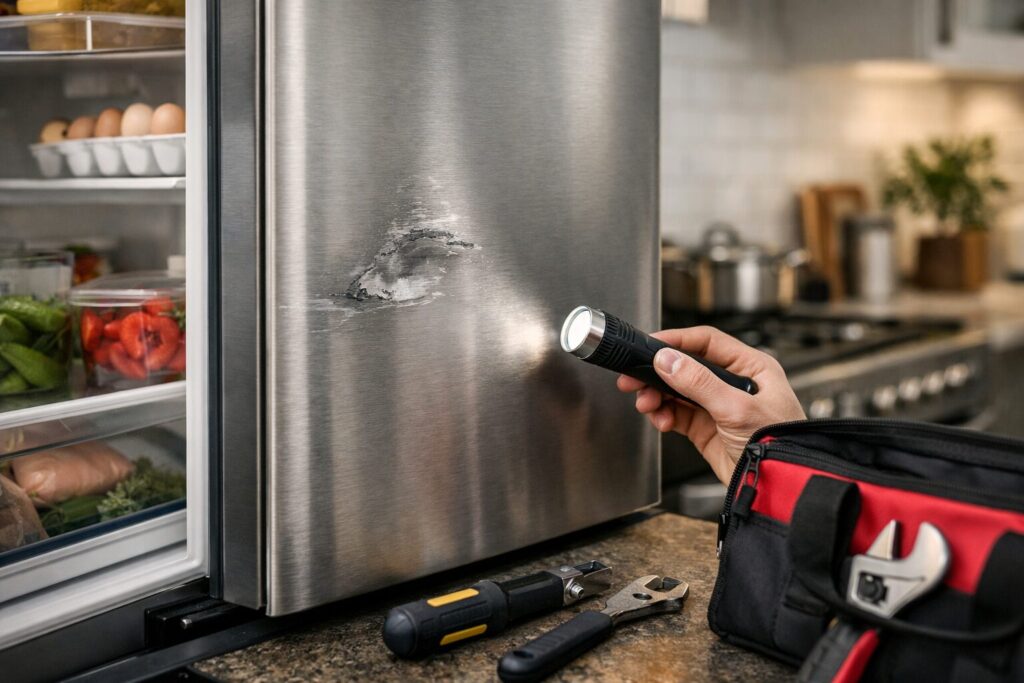
Sometimes. Cosmetic damage like scratches and dents usually does not affect the core lifespan of an appliance, but if the damage exposes metal to moisture, creates sharp edges, or causes parts to misalign, it can sometimes lead to rust, corrosion, or secondary mechanical issues over time. Repair professionals often report that most minor cosmetic flaws are only surface deep, but deeper dents or chipped finishes—especially on refrigerators, washers, and dishwashers—can increase the risk of rust or eventual leaks if not addressed. Many scratch and dent appliances work just as long as new models, but homeowners should inspect for exposed metal, compromised seals, or any impact to doors or hinges. Extended protection plans from CPS can help with eligible mechanical and electrical failures, but cosmetic-only damage is generally not covered.
Quick Summary: Cosmetic Damage and Appliance Lifespan
Here’s what you need to know about how cosmetic damage might affect a scratch and dent appliance:
- Minor scratches and dents usually do not impact the appliance’s core lifespan or function.
- Damage that exposes bare metal or damages seals can increase the risk of rust, leaks, or long-term wear.
- Factory-authorized repair providers often recommend monitoring for signs of corrosion or misaligned doors after a dent.
- Cosmetic-only issues are generally not covered by warranty or protection plans; coverage focuses on mechanical or electrical failures.
- Many customers find that scratch and dent appliances offer the same reliability if the core components are unaffected.
|
Topic |
Quick Take |
|---|---|
|
Does cosmetic damage affect lifespan? |
Usually no, unless damage exposes metal or affects seals |
|
What should you watch for? |
Rust, corrosion, misaligned doors, exposed metal, or leaks |
|
Are cosmetic issues covered? |
Generally excluded from warranty coverage |
|
Are scratch and dent appliances reliable? |
Often just as reliable if core parts are intact |
|
Can CPS help with repairs? |
CPS covers eligible mechanical/electrical failures, not cosmetic-only issues |
free
Limited Time Offer
Get 3 months free on any protection plan.
Don’t wait for something to break. Get covered today and your first three months are on us.
What Should You Look For When Buying a Scratch and Dent Appliance?
When comparing scratch and dent appliances, it’s important to look beyond the surface and focus on potential hidden issues that could affect performance or longevity. Customers often want to know what types of cosmetic damage are harmless and which might lead to bigger problems down the road.
- Inspect for exposed metal, chipped paint, or compromised seals
- Check that doors, hinges, and handles operate smoothly
- Ask if any dents have affected internal parts or insulation
- Review warranty details for coverage of mechanical and electrical failures
- Confirm eligibility for extended protection if considering a plan
What Experience Does CPS Have With Scratch and Dent Appliance Protection?
For many customers purchasing scratch and dent appliances, understanding real-world repair risks and warranty coverage is important—especially as appliances age. With more than 75 million products covered, 50,000 servicers nationwide, and over $450 million in claims paid annually, CPS has extensive experience supporting appliance owners through post-warranty repairs and coverage for new, refurbished, and open-box products.
- Based on CPS’s historical claims data, most cosmetic-only damage does not lead to early appliance failure
- Repairs related to rust or corrosion are more common when dents expose bare metal or compromise protective coatings
- Mechanical and electrical failures are far more likely to affect appliance lifespan than surface scratches or dents
- Factory-authorized servicers often advise addressing exposed metal or broken seals quickly to prevent secondary issues
- Scratch and dent appliances with only minor flaws typically offer similar reliability to new models if inspected properly
What Appliance Repairs Are Most Common With Scratch and Dent Products?
Based on CPS’s historical claims data and long-term repair trends, most claims for scratch and dent appliances involve standard mechanical or electrical failures—not issues caused by cosmetic flaws. However, repairs related to rust, leaks, or door misalignment can occasionally be traced back to deeper dents or damaged finishes, especially if left unaddressed.
|
Product or Repair Type |
Common Issue |
Why It Can Be Expensive or Important |
CPS Repair Insights |
|---|---|---|---|
|
Refrigerator |
Rust or corrosion from exposed metal |
Can lead to leaks or cooling loss if spreads to internal components |
CPS claims data shows refrigerator corrosion-related claims often escalate 3–6 years into ownership after scratches expose metal near lower door seams or dispenser areas. Historical CPS repair data suggests roughly 28% of rust-related service events eventually involve secondary cooling or moisture issues, especially when oxidation reaches insulation cavities or wiring channels. Claims involving these failures typically require gasket replacement, panel treatment, or evaporator-area repairs ranging from $320–$950, while severe internal corrosion can push repairs close to 45%–60% of replacement value. |
|
Dishwasher |
Door seal damage from dented panel |
May cause water leaks and internal moisture damage |
Based on CPS claim trends, dishwasher door alignment problems frequently appear 2–4 years after purchase when dented outer panels slowly compromise gasket pressure and latch positioning. CPS repair history shows leak-related claims tied to warped or misaligned doors have nearly 30% higher repeat-visit rates because moisture intrusion can affect float switches, insulation, and wiring harnesses behind the tub. Approved CPS appliance claims for these repairs commonly range from $280–$740 depending on whether seal replacement alone resolves the issue or additional electrical drying and calibration are required. |
|
Washer/Dryer |
Drum or door misalignment after a heavy dent |
Can result in loud operation, leaks, or excessive wear |
Historical CPS repair records indicate washer and dryer misalignment claims commonly emerge during mid-life ownership periods after cabinet dents alter suspension balance or hinge alignment. CPS claims activity indicates front-load washer repairs involving vibration, door leaks, or drum contact often require multiple service visits because technicians must inspect bearings, actuators, suspension rods, and alignment tolerances together. Repair invoices for these claims typically run between $420–$1,150, with higher approval rates when vibration damage spreads to motor assemblies or control boards 4–7 years into ownership. |
|
Oven/Range |
Damaged insulation or warped door |
Heat loss or uneven cooking, higher energy use |
According to historical CPS repair records, oven and range door-warp claims increase shortly after manufacturer warranty expiration as repeated thermal cycling weakens hinges, insulation barriers, and door seals. CPS repair history shows uneven heating complaints tied to dent-related warping frequently lead to relay board strain and extended preheat times, particularly in convection models. Claims involving these failures typically require hinge assemblies, insulation replacement, or recalibration work totaling $350–$980, while high-end ranges with glass or smart-control systems can exceed $1,400 in authorized repair exposure. |
|
Any Appliance |
Paint chips exposing metal |
Increased risk of rust over time, especially in humid areas |
Service history from CPS claims indicates exposed metal from chipped finishes becomes far more problematic in humid climates or laundry-area installations where condensation accelerates corrosion. Based on CPS claims data from comparable repair events, cosmetic damage itself rarely triggers immediate failure, but untreated oxidation contributes to mounting weakness, panel deterioration, and eventual component exposure 5–8 years into ownership. Secondary repairs connected to corrosion escalation commonly add $250–$600 in labor and parts costs, particularly when rust spreads near hinges, compressor mounts, or electrical grounding points. |
Why Do Customers Choose CPS Protection Plans?
Customers choose CPS for appliance protection because of flexible coverage options, claims experience, and support for new, open-box, and scratch and dent appliances. Our repair network and claims administration help customers navigate post-warranty repairs and long-term ownership concerns.
- Support for repaired and scratch and dent appliances when eligible
- Access to a large authorized service network for mechanical and electrical failures
- Clear claims process and repair coordination support
- Protection available for many new, open-box, and refurbished appliances
- Assistance after manufacturer warranty expiration for eligible products
Can CPS Help if My Appliance Is Already Out of Warranty?
For many homeowners, repair concerns become more important after the original manufacturer warranty expires. CPS may still be able to help connect customers with troubleshooting guidance, repair referrals, and, for certain eligible products, extended protection options even after the initial purchase.
- Troubleshooting guidance and repair coordination for out-of-warranty appliances
- Referral assistance to authorized repair providers and parts sources
- Eligibility checks for extended protection on certain products after purchase
- Guidance on repair versus replace decisions for aging or scratch and dent appliances
|
Contact Method |
Details |
Best For |
|---|---|---|
|
Phone |
(800) 905-0443 |
Speaking directly with a CPS representative |
|
Web Chat |
|
Quick support and troubleshooting guidance |
|
CPS Client Care Portal |
https://client.cpscentral.com/ |
Claims, account access, and service support |
|
Text Message |
Text (347) 621-7180 |
Quick customer support questions |
|
Facebook Messenger |
http://m.me/ConsumerPriorityService |
General support and communication |
|
|
cs@cpscentral.com |
Detailed questions and documentation |
What Questions Do Customers Ask About Scratch and Dent Appliance Coverage?
Can cosmetic damage actually shorten the lifespan of an appliance?
Usually, cosmetic damage like minor scratches or surface dents won’t affect how long an appliance lasts, but untreated exposed metal or deep dents can lead to rust or mechanical issues if moisture gets inside.
Are scratch and dent appliances as reliable as brand new ones?
Many scratch and dent appliances are just as reliable as new models when the damage is only cosmetic and does not affect critical components or seals.
Does a protection plan cover cosmetic damage?
No, protection plans—including those from CPS—generally do not cover cosmetic damage like scratches or dents. Coverage focuses on mechanical and electrical breakdowns.
What should I check before buying a scratch and dent appliance?
Inspect for exposed metal, compromised seals, and make sure doors and hinges operate smoothly. Ask if the cosmetic damage affected internal parts or insulation.
Can I get a warranty on a refurbished or scratch and dent appliance?
Yes, many scratch and dent and refurbished appliances are eligible for protection plans from CPS, but eligibility depends on the product’s condition and age.
Will rust from a dent be covered under a protection plan?
No, rust due to cosmetic damage is usually considered a maintenance or cosmetic issue and is not covered. Mechanical failures caused by corrosion may be eligible if not due to pre-existing or cosmetic-related damage.
What repairs are most common in scratch and dent appliances?
Mechanical and electrical failures like control board issues or leaks are most common, while cosmetic damage rarely leads directly to claims based on CPS’s historical data.
Is it safe to buy a scratch and dent refrigerator or washer?
Yes, as long as the damage is superficial and does not affect the internal components, seals, or insulation. Always inspect for signs of exposed metal or compromised doors.
Can CPS help if my appliance is out of warranty and develops a problem?
CPS can assist with troubleshooting, repair referrals, and, for certain eligible products, extended protection options even after manufacturer warranty expiration.
Do scratch and dent appliances lose value faster?
They may have a lower resale value due to appearance, but their functional lifespan is typically similar to undamaged models if the core components are unaffected.
repair
No Hidden Fees
One price covers all parts, labor, makes & models.
Skip the guesswork. Our flat rate repair program means you know exactly what you’ll pay — before we start.
Looking for Warranty Coverage Options?
If you’re considering protection for a scratch and dent appliance or want to learn more about your options, CPS can help you review coverage, check eligibility, and answer your repair questions.
For many customers, scratch and dent appliances offer the same long-term reliability as new models if the core mechanics and seals are intact. As appliances age, the risk of mechanical or electrical failure increases, making post-warranty repair costs and support more important. If you’re planning to keep your appliance for several years, exploring extended protection or repair support can help with expensive repairs that may arise down the road. Check your product’s eligibility or contact CPS for practical guidance and coverage options.
 SPECIAL OFFER
 Coverage for scratch & dent models